Written By

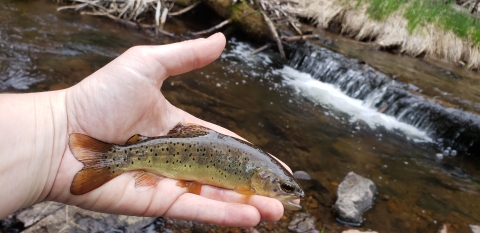
The Apache trout, once on the brink of extinction, can only be found in the cold, high-elevation waters of Arizona—a state few associate with a cold-water trout species. But Apache trout are resilient—persisting through decades of threats long enough so that the power of partnerships could bring them back.
This species’ path to recovery began in 1955, when the White Mountain Apache Tribe first recognized steep population declines and subsequently closed the Fort Apache Indian Reservation to fishing, a decisive action that saved the species from extinction. Apache trout were first listed as federally endangered in 1967 under the precursor to the Endangered Species Act (ESA) and gained formal ESA protection in 1973.
Since 1955, the relict populations that remained have been bolstered, protected, and replicated across the landscape. In 1975, the species was downlisted to threatened. Following continued habitat restoration, nonnative fish removal, and population expansion across streams on tribal, federal, and state lands, the species was proposed for delisting in August 2023 and officially removed from the endangered species list in September 2024.
This recovery didn’t happen alone. Conservation and eventual recovery of the Apache trout has been a collaborative effort across many partners, including the White Mountain Apache Tribe, San Carlos Apache Tribe, Arizona Game and Fish Department, U.S. Forest Service, Trout Unlimited, and the U.S. Fish and Wildlife Service—across both the Fish and Aquatic Conservation Program and Partners for Fish and Wildlife (PFW) Program.
The PFW Program’s Role in Recovery
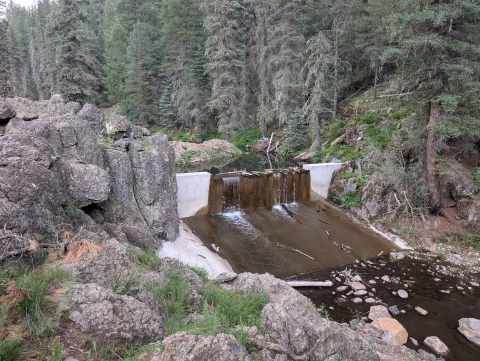
Since 1999, the PFW Program has provided financial and technical assistance for Apache trout recovery efforts. One of the most significant recent contributions was helping fund the replacement of the Big Bonito Creek Barrier. The original barrier, built in the 1980s or 1990s, had deteriorated and no longer prevented nonnative trout from swimming upstream into Apache trout habitat. Replacing it became a top priority as doing so would protect nearly 22 miles of stream—roughly 18 percent of all remaining Apache trout recovery habitat. With additional funding from the White Mountain Apache Tribe, Arizona Fish and Wildlife Conservation Office, Desert Fish Habitat Partnership, Bureau of Reclamation, National Fish and Wildlife Foundation, and other Service funds provided through the Fish Passage Program and Ecological Services, the new barrier was completed in 2025.
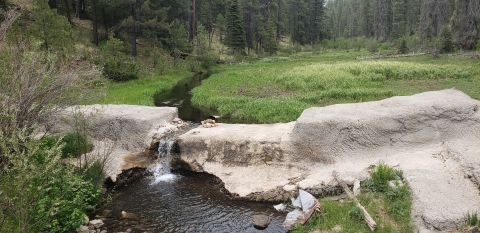
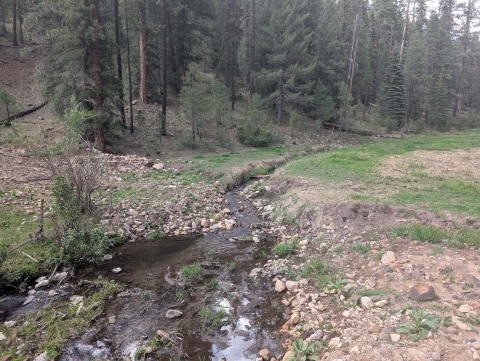
The PFW Program’s support extends beyond large infrastructure projects. In Flash Creek, PFW Program biologist Jennifer Graves is using her stream-geomorphology training to assist with an ongoing habitat restoration project benefiting one of the remaining relict Apache trout populations. In a meadow stretch of the creek, where flows are intermittent or seasonally dry, she is working with partners to improve stream health by fencing off riparian riparian
Definition of riparian habitat or riparian areas.
Learn more about riparian areas to exclude livestock so native vegetation can recover, planting additional riparian plants for shade and bank stability, and installing simple instream structures—such as beaver-dam analogs and one-rock dams—to slow water, reduce erosion, and increase habitat complexity. Three stream reaches are being surveyed and monitored for changes in channel shape, substrate, habitat conditions, and temperature before and after restoration to track how the system responds over time.
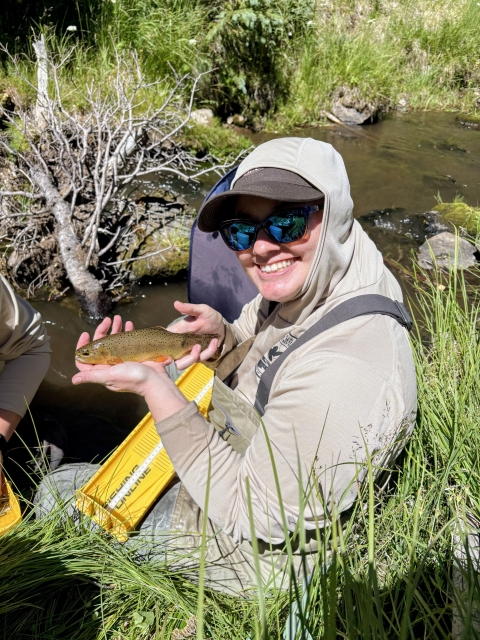
Since 2019, Graves has also supported recovery efforts through grant and report development, data management, assisting with spawning at Williams Creek National Fish Hatchery, and collecting wild milt for cryopreservation— a tool that helps preserve the species’ genetic diversity for the future. She has also assisted with fish-tagging studies to evaluate barrier effectiveness, nonnative trout removal, and training seasonal crews on population monitoring surveys.
Continuing the Legacy of Protection
Even with the Apache trout now delisted, conservation work is far from over. The PFW Program will continue to support long-term protection of the species and its habitat—helping ensure this resilient native trout remains part of Arizona’s mountain streams for generations to come.
Additional Information
To learn more about Apache trout recovery efforts, check out the story Apache Trout Conservation, which provides additional background and resources.