On a quiet island in Hawai‘i, a small, bright orange native insect may soon return home, thanks to an innovative partnership and a first‑of‑its‑kind conservation benefit agreement between the U.S. Fish and Wildlife Service (Service), the State of Hawaiʻi, and the local Pūlama Lānaʻi land management company.
Because many of our most at-risk species occur largely on privately owned property, the involvement of the private sector in the conservation and recovery of species is crucial. Conservation Benefit Agreements (CBAs) are voluntary agreements that provide incentives for non-Federal property owners to work with the Service to conserve species. Property owners agree to undertake specific conservation measures that help address identified threats for the agreement’s covered species. In return, the Service authorizes take of the covered species while the conservation actions are implemented, and provides the property owner with assurances that their conservation efforts will not result in future regulatory obligations beyond those established in the CBA.
Announced in 2024, CBAs are modeled on Safe Harbor Agreements and are designed to reduce the burden of conserving species on private lands. Actions taken under CBAs provide a net conservation benefit that contributes to the conservation or recovery of threatened and endangered species throughout the United States.
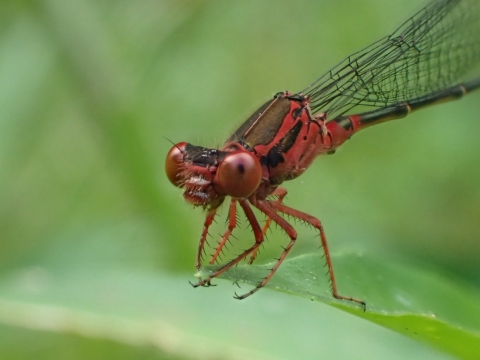
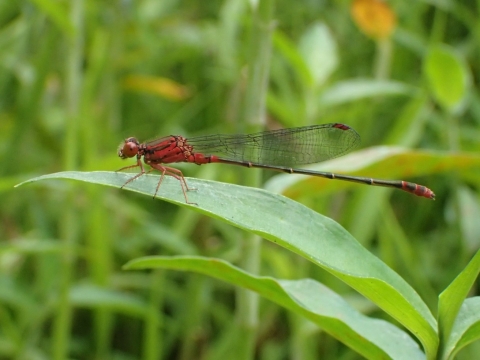
In 2025, the Service worked with partners to complete the first CBA in the United States, focused on the reintroduction of the orangeblack Hawaiian damselfly on Lānaʻi, a small and mostly privately-owned Hawaiian island west of Maui. The effort was led by the Pūlama Lānaʻi land and resource management company who worked diligently with the Service’s Pacific Islands Fish and Wildlife Office and the Hawai‘i Division of Forestry and Wildlife to develop new tools to benefit the damselfly and other threatened and endangered species on Lānaʻi.
The orangeblack Hawaiian damselfly (Megalagrion xanthomelas) is found only in the Hawaiian Islands and was once the most abundant damselfly species in Hawaiʻi. Tiny, quick, and strikingly patterned, it is now limited to 34 known populations across Hawaiʻi and is no longer found at all on Kauaʻi or Lānaʻi. The number of orangeblack Hawaiian damselflies in the wild is unknown, and they were listed as endangered in 2016.
The tiny damselfly, known as pinapinao in Hawaiian, inhabits low elevation streams, wetlands, and landlocked brackish pools, and over their lifetimes they do not stray far from their breeding pools. One of the greatest threats to the species includes wetland and stream habitat loss, as well as non-native plants, agriculture, urban development, invasive fish, and habitat destruction by feral pigs. Recovery will require many steps, including re-establishing self-sustaining populations on Lānaʻi, and ensuring reliable water resources and protected artificial habitat is available.
The CBA was developed to support these recovery goals by developing breeding habitat and providing a predator-free safe zone for reintroduction of captive-reared damselflies on Lānaʻi.The agreement includes detailed conservation measures for introducing the orangeblack Hawaiian damselfly to a conservation area conservation area
A conservation area is a type of national wildlife refuge that consists primarily or entirely of conservation easements on private lands. These conservation easements support private landowner efforts to protect important habitat for fish and wildlife and major migration corridors while helping to keep agricultural lands in production.
Learn more about conservation area on Lānaʻi, while describing how the Parties will work together to implement shared goals to benefit species and create habitat. Reintroduction is an important step toward the recovery goals for the species, which includes establishing new populations that can exist within habitat capable of supporting natural dispersal, improving breeding opportunities, and expanding the occupied range on each island.
"Bringing pinapinao back home to Lānaʻi is part of our longstanding commitment to E mālama iā Lānaʻi — to care for Lānaʻi as it cares for us," said Dr. Rachel Sprague, co-Director of Conservation for Pūlama Lānaʻi. "We are grateful to the U.S. Fish and Wildlife Service for their ongoing partnership, and especially for working with us to honor our responsibility to this island, its community, and its biocultural history through this CBA."

In 2025, the Service recognized the Pūlama Lānaʻi team as Recovery Champions for their work on the CBA, as well as their long efforts to advance the recovery of more than 40 threatened and endangered species on Lānaʻi.
The Service is proud to support this highly effective partnership and focused long-term conservation work — an important step to ensure that the remarkable native orangeblack Hawaiian damselfly has a chance to once again thrive on Lānaʻi.
“Strong partnership and trust made this CBA possible, giving landowners predictability while protecting vital habitat,” said Chelsie Javar-Salas, supervisory biologist for the Pacific Islands Fish and Wildlife Office. “Without these partners, species dependent on private lands would continue to decline and could vanish from the natural and cultural landscape of Hawai'i. By aligning conservation goals with private interests, we help ensure these places and species endure for generations. The endemic species of Hawai'i are ʻohana (family), and caring for them is our shared responsibility."