Written By

In Alaska, the Coastal Program is an important component of the U.S. Fish and Wildlife Service’s (Service) voluntary habitat conservation approach to restoring and conserving functioning habitat for Pacific salmon. The Alaska Habitat Restoration Program has made a long-term commitment to restoring and maintaining aquatic connectivity, primarily through the removal of culvert barriers at road stream crossings.

Southeast Alaska has been a focus of this effort for decades because of its rich salmon resources. Southeast Alaska features rainforests, fjords, a myriad of rivers and streams, estuaries, mountains, and glaciers. It ranks as one of the largest, most complex, and intact estuarine and temperate rainforest systems on Earth. Despite having healthy salmon runs that support a robust fishing economy, many of the region’s watersheds suffer from the legacy of industrial logging and land development. These watersheds are culturally and economically important to numerous small, remote Native Alaskan communities that have subsisted on the natural resources here since time immemorial.
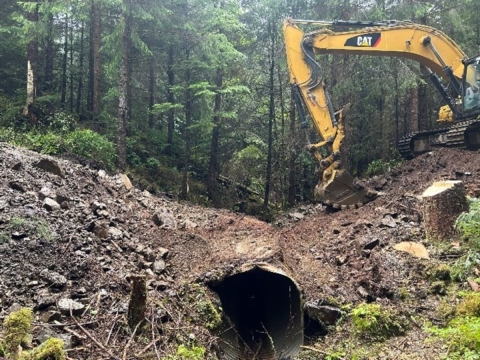
The Service partners with Federal and State agencies, Tribes, tribal organizations, and non-government organizations to identify, assess, prioritize, and remove as many fish passage fish passage
Fish passage is the ability of fish or other aquatic species to move freely throughout their life to find food, reproduce, and complete their natural migration cycles. Millions of barriers to fish passage across the country are fragmenting habitat and leading to species declines. The U.S. Fish and Wildlife Service's National Fish Passage Program is working to reconnect watersheds to benefit both wildlife and people.
Learn more about fish passage barriers as possible. Key partners in Southeast Alaska include: U.S. Forest Service, Natural Resources Conservation Service, National Oceanic and Atmospheric Administration, Alaska Department of Fish and Game, a network of Tribal Forest Partnerships, Sealaska Corporation, the Metlakatla Indian Community, Trout Unlimited, and the Southeast Alaska Watershed Coalition.
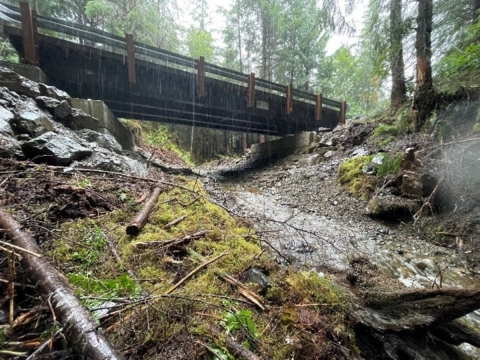
The Service invests financial and technical assistance, leverages the resources of partners, and maximizes local capacity and knowledge to deliver efficient projects with many benefits beyond salmon conservation. Aquatic connectivity restoration and floodplain reconnection increase resilience to flooding, erosion, and extreme weather, which translates to lower infrastructure maintenance costs for local governments and landowners. These restored watersheds improve salmon population productivity, supporting local food security and the region’s fishing industry, a major driver of community livelihoods.Moreover, working directly with the local workforce ensures the inclusion of indigenous and local knowledge and benefitting local communities by supporting local businesses and stimulating local economies.
Since 2006, the Service’s aquatic connectivity restoration efforts in Southeast Alaska have removed 156 barrier culverts, reactivated riparian riparian
Definition of riparian habitat or riparian areas.
Learn more about riparian habitat and the floodplain, and restored fish access to 120 miles of highly productive salmon habitat. Restoring watersheds via this Federal–State–Tribal–private collaboration demonstrates how we can heal degraded landscapes, strengthen local capacity for long-term stewardship, and support Coastal Program’s national priorities of species conservation, habitat connectivity, and resilient ecosystems.