Written By

In northwest Wisconsin, the Bois Brule River watershed is a stronghold for native brook trout—a species that thrives in cold, connected waters. However, undersized and aging road-stream crossings have fragmented this habitat, creating barriers to fish passage fish passage
Fish passage is the ability of fish or other aquatic species to move freely throughout their life to find food, reproduce, and complete their natural migration cycles. Millions of barriers to fish passage across the country are fragmenting habitat and leading to species declines. The U.S. Fish and Wildlife Service's National Fish Passage Program is working to reconnect watersheds to benefit both wildlife and people.
Learn more about fish passage and threatening both ecological integrity and community infrastructure.

The U.S. Fish and Wildlife Service (USFWS) Coastal Program, along with the National Fish Passage Program, partnered with Trout Unlimited (TU), Wisconsin Department of Agriculture, Trade and Consumer Protection (DATCP), Wisconsin Department of Natural Resources (WDNR), the Trout and Salmon Foundation, Brule River Sportsmen Club, and Douglas County, WI to remove barriers and improve connectivity. Wilson Creek, a Class 1 trout stream and tributary to the Bois Brule River, contained three culverts that were perched and undersized, blocking trout and other aquatic organisms from accessing critical spawning and thermal refuge habitat. Restoring fish passage for brook trout in headwater streams of the Bois Brule, like Wilson Creek, is a critical step to supporting a trophy brook trout stream in northern Wisconsin. Beyond ecological impacts, these structures increased flood risks for local communities impeding natural stream flow and threatening road safety during high-water events.
Starting in 2021, the Coastal Program funded survey and design work for four priority crossings in the watershed, including two on Wilson Creek. at County Highway P. Using Stream Simulation Design Methods, engineers developed plans for crossings that mimic natural stream conditions, restore connectivity, and improve flood resiliency. These designs were later implemented with USFWS National Fish Passage Program funding and additional support from local partners. In 2023–2024, TU led the replacement of the two Highway P culverts, building on earlier success at East Stone Chimney Road. The new structures reconnect 2.63 miles of Wilson Creek to the Bois Brule River, opening habitat for brook trout and other cold water species.
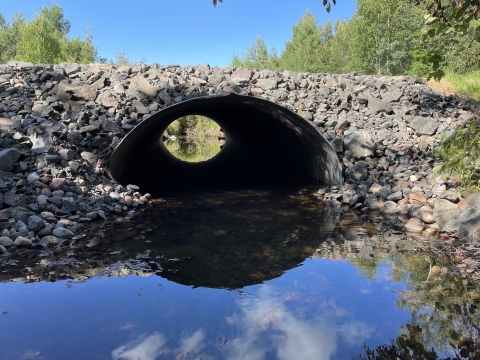
The project benefits are clear—brook trout and other aquatic species now have access to spawning grounds and thermal refuges essential for survival. The new crossings also reduce flood risk and protect local roads. The habitat improvements have enhanced recreational fishing opportunities on Wilson Creek, and TU uses the new road crossings as demonstration projects to promote replacement of degraded road culverts.
This project exemplifies how federal programs, nonprofits and local governments can collaborate to tackle complex conservation challenges. By blending science-based design with community engagement, partnerships like this are restoring connectivity in the Great Lakes watersheds—one stream at a time.