Written By

A five-foot culvert on Clear Creek in Wahkiakum County in southern Washington was failing and blocked access to two miles of spawning habitat along Clear Creek for at least three Pacific salmon species and other aquatic species. The culvert also created a potential public safety hazard for drivers using Elochoman Valley Road since it was unlikely to withstand a 100-year flood and it was tucked up against the hillside creating a blind curve on a road that carries loaded logging trucks.
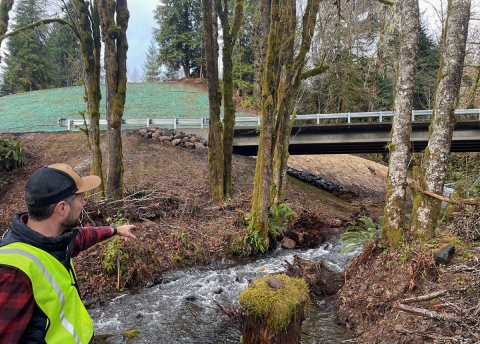
The Washington Coastal Program worked with the Columbia River Estuary Taskforce (CREST) and Wahkiakum County Public Utility District to replace the failing culvert with a 100-foot channel bridge. In addition to providing financial and regulatory support, the Coastal Program conducted habitat surveys, supported community outreach, and helped expedite construction to ensure the bridge installation did not impact potential nesting habitat for the federally threatened marbled murrelet that frequents the Willapa Hills.
The project restored natural stream functions and connectivity and enhanced more than half a mile of riparian riparian
Definition of riparian habitat or riparian areas.
Learn more about riparian and stream habitat. Located upstream of Julia Butler Hansen National Wildlife Refuge, the project advances Service and regional conservation goals and supports Pacific salmon recovery. Residents commented that the new bridge makes it easier for drivers and pedestrians to see the traffic coming down the hill.

Observations of Pacific salmon migrating upstream confirm the project is contributing to sustainable Pacific salmon populations. Ongoing monitoring by the Columbia River Estuary Study Taskforce will inform adaptive management and increase stream resilience, benefiting water quality, flood protection, and public safety.