Written By

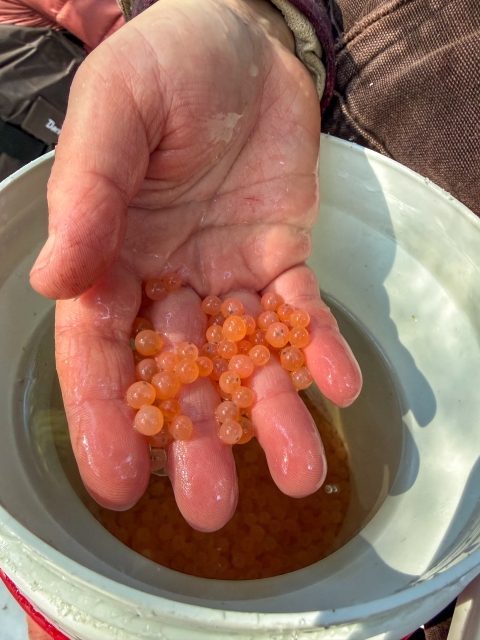
Last month, the U.S. Fish and Wildlife Service’s (USFWS) Gulf of Maine Coastal Program (GOMCP) staff teamed up with the Maine Department of Marine Resources (DMR) for their annual Atlantic salmon egg planting on the Sheepscot River along Maine’s central coast. DMR developed this hands-on restoration technique more than a decade ago to boost juvenile Atlantic salmon production in Maine’s gravel-bottomed rivers and streams.
Historically, hundreds of thousands of Atlantic salmon returned to rivers across New York and New England each year, including up to 100,000 to Maine’s Penobscot River alone. Following European settlement, timber harvesting, the fur trade, and early mills began altering Maine’s rivers, reducing salmon habitat. By the 1800s, agriculture, dams, and log drives further degraded streams, causing dramatic population declines. Today, naturally spawning Atlantic salmon return in small numbers to only a handful of rivers in central and eastern Maine, forming the Gulf of Maine Distinct Population Segment, listed as Endangered under the U.S. Endangered Species Act (ESA) since 2000.
In recent decades, poor ocean survival, driven by northward shifts in prey, changing ocean conditions, and predation, has further challenged recovery efforts. Hatcheries have prevented salmon from disappearing entirely, and juveniles raised in natural river habitats survive at higher rates, highlighting the importance of in-river restoration.
The USFWS supports recovery by managing conservation hatcheries, conducting research, implementing ESA protections, conducting Federal Energy Regulatory Commission (FERC) hydropower reviews, and working collaboratively with partners to restore habitat connectivity, improve fish passage fish passage
Fish passage is the ability of fish or other aquatic species to move freely throughout their life to find food, reproduce, and complete their natural migration cycles. Millions of barriers to fish passage across the country are fragmenting habitat and leading to species declines. The U.S. Fish and Wildlife Service's National Fish Passage Program is working to reconnect watersheds to benefit both wildlife and people.
Learn more about fish passage , and enhance in-stream habitat. Atlantic salmon recovery in Maine is a collaborative effort uniting agencies, hatcheries, and local partners to help restore this iconic species and a piece of Maine’s natural heritage.
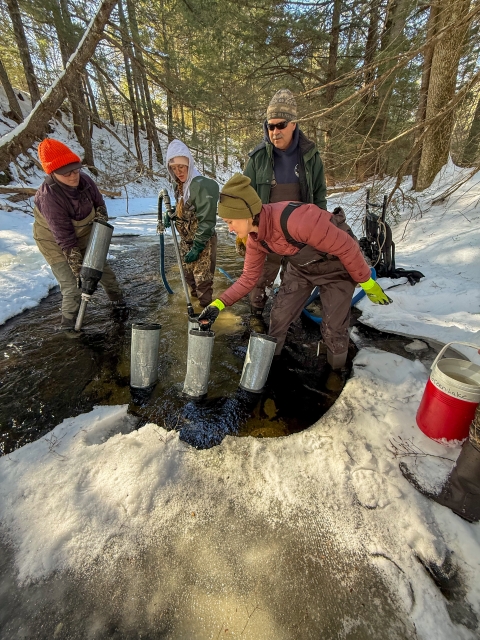
In this effort, crews from GOMCP and DMR planted 25,000 fertilized eggs collected from adult Atlantic salmon females at Green Lake and Craig Brook National Fish Hatcheries into prime spawning habitat at two sites on the main stem and West Branch of the Sheepscot River. Using a specialized water cannon and cone system, the team clears fine sediment from the river bottom, deposits hundreds of eggs at a time, and then lets water suction gently pull the eggs down into the gravel. The process mimics how adult salmon naturally build their nests, called “redds.”
The eggs are expected to hatch this spring, adding to local juvenile salmon populations and supporting recovery efforts in the Merrymeeting Bay Salmon Habitat Recovery Unit. This work is part of a broader strategy that also includes habitat restoration, such as adding in-stream log structures to improve flow, and removing migration barriers. By working across multiple watersheds and with a collaborative network of partners, these restoration efforts are building a path toward recovery for this iconic species.