Written By

In the southeast corner of Wisconsin, just a few miles from the shores of Lake Michigan, a transformation is underway at the newly established Gitzlaff Park. The park, a 24-acre property donated to the Village of Somers in Kenosha County by a local resident in 2007, is undergoing restoration to convert an old agricultural field into a public park complete with trails and native prairie and wetland habitats. These efforts, along the Somers Branch of the Pike River, are being undertaken by a team of partners led by the Root-Pike Watershed Initiative Network (Root-Pike WIN).
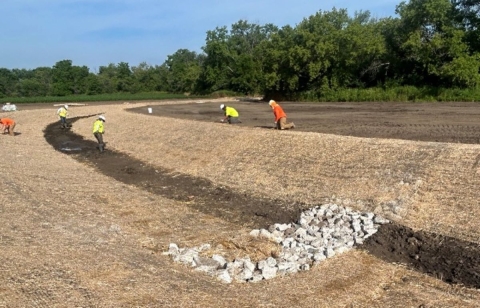
With financial support from the U.S. Fish and Wildlife Service (USFWS) Coastal Program, Root-Pike WIN recently completed phase two of the restoration project to create two acres of wetlands, restore three acres of surrounding uplands, and reconnect 0.22 miles of stream to the floodplain to support habitats for migratory birds, native pollinators, and a variety of aquatic species.
These habitat improvements will benefit the local community by reducing flooding and erosion in Somers Branch and decreasing pollutants that flow through the community waterways and eventually into Lake Michigan. The transformation of traditional farmland into high-quality floodplain and upland habitats will not only improve the water quality but will also boost pollinator and vegetation diversity and improve native oak savanna habitat to benefit monarch butterflies, blue-winged teal, northern pike, rusty patched bumble bees, and many other native and migratory species. Because this project is located in a public park, it will have the added benefit of raising awareness about the importance of restoring native land types for water quality, flood reduction, and species conservation.
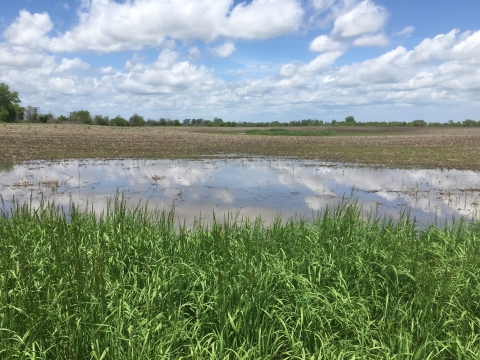
The completed Phase 2 project, with additional funding from the Fund for Lake Michigan, included creating three shallow pools, or scrapes, in the wetland area to provide new aquatic habitat for coastal species, breaking old drainage tiles and reconfigure channels to reconnect the floodplain, removal of invasive trees, and stream stabilization using the repurposed cut trees and vegetation plantings to reduce erosion during highwater events.
The restored stream channel performed well during summer rain events, allowing high water flows to reach the floodplain and wetland scrapes. During the dry summer the partners were excited to observe that after weeks of no rain, the channel still held water and small crayfish have been observed in the pools. While additional restoration remains to be completed at Gitzlaff Park, Root-Pike WIN and the Coastal Program staff are excited about the success of phase 2 and the potential project benefits of the local communities and native species in Southeast Wisconsin.