Written By


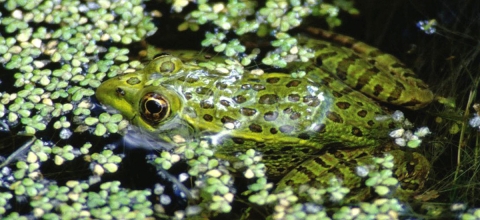
Across Arizona, the U.S. Fish and Wildlife Service’s (Service) Partners for Fish and Wildlife (PFW) Program is teaming up with private landowners, the Arizona Game and Fish Department (AGFD), and other conservation partners to recover the federally threatened Chiricahua leopard frog. This partnership began in 2006, when AGFD and the Service signed a Safe Harbor Agreement (now known as Conservation Benefit Agreement)—an innovative, voluntary agreement that promotes long-term conservation on private lands for the species. Today, 25 private landowners participate in the program, conserving more than 72,000 acres of non-federal lands that support 26 Chiricahua leopard frog populations.
As part of this effort, the PFW Program has been partnering with multiple landowners in southeastern Arizona to construct and enhance a network of ponds that support Chiricahua leopard frog breeding and reintroduction efforts. These projects contribute to the species’ recovery by reconnecting fragmented habitat and increasing the number of occupied sites across private lands.
Restoration in Action
Several of these restoration efforts are underway within the Fort Huachuca Sentinel Landscape. In one project, the PFW Program and a local ranching partner recently installed permanent water sources that benefit livestock, wildlife, and Chiricahua leopard frogs. As the partnership moves into its next phase, portions of key stock tanks will be fenced to encourage native vegetation recovery while still allowing both cattle and Chiricahua leopard frogs safe access to water. This work demonstrates how practical, low-cost improvements can support ranch operations while enhancing habitat for a threatened species.
In another project within the Sentinel Landscape, the PFW Program worked with a conservation partner to enhance a pond originally designed for migratory waterfowl and other birds so it could also support Chiricahua leopard frog reintroduction. The improved site now provides habitat for four additional federally listed species, creating a refuge for an array of wildlife and demonstrating how a single restoration project can deliver lasting benefits for multiple species.
By partnering with Arizona ranchers and conservation partners, the PFW Program and AGFD illustrate that public-private partnerships are an effective way to restore vital habitat while enabling both conservation efforts and agriculture to thrive together.