Written By

In 2021, the U.S. Fish and Wildlife Service’s Partners for Fish and Wildlife (PFW) Program in central Florida began a collaborative habitat restoration effort with the Indian Hammock Hunt and Riding Club (IHHRC), a unique homeowner’s association in Okeechobee County, Florida. The club’s resident members enjoy access to community-managed natural areas for trail riding, wildlife viewing, and hunting (deer, turkey, quail). The Florida Fish and Wildlife Conservation Commission had developed habitat management recommendations for the club, and IHHRC sought assistance implementing them.
Building Trust and Establishing a Collaborative Framework
The PFW Program project focused on restoring native habitats and reducing risks such as wildfires and flooding, while empowering the club to implement management with their own staff and members. Building trust was key: PFW Program staff met with members of the community preservation committee, the club membership board, and presented the agreement to the entire membership for vote.
Restoration Success Reflected After Hurricane Ian
Initial skepticism gave way to confidence as results emerged. When Hurricane Ian struck in late 2022, the IHHRC property experienced only minimal flooding—a clear sign that restoration efforts were paying off. PFW Program funding targeted invasive aquatic species along 1.5 miles of the main drainage canal, restoring its function and freeing staff to treat 26 miles of roadside ditches. Residents credited the project with improving water flow, protecting homes and infrastructure, and enhancing the aquatic ecosystem.
Innovative Drone Techniques for Invasive Species Control
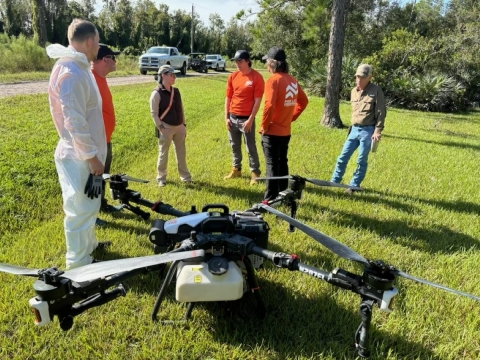
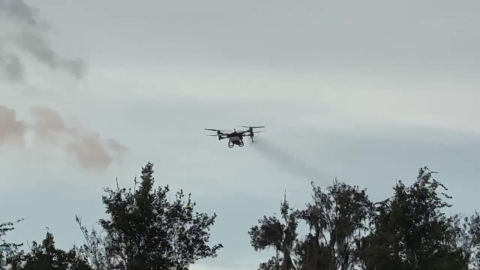
The team also identified 70 acres of hardwood swamp wetland heavily infested with invasive climbing fern, which had displaced native vegetation and degraded habitat quality. These wetlands provide critical cover, food, and movement corridors for deer, black bears, Florida panthers, and migratory birds. Nearby residents raised concerns about wildfire risk, as dense fern growth can fuel intense burns. To address these challenges, the project deployed drone technology for herbicide application—an innovative, cost-effective alternative to helicopters or ground crews. This approach allowed precise treatment in hard-to-reach areas while minimizing disturbance to sensitive habitats and neighboring properties.
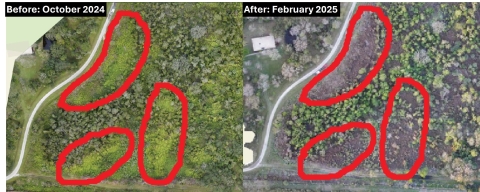
In October 2024, the licensed drone operator mapped the site using a fixed-wing drone and deployed two 4-blade spray drones with 8-gallon capacities. The drones flew staggered shifts, allowing continuous application. The total area was completed in just a few hours. Ground surveys 30 days later showed strong suppression of climbing fern, with infestations that had reached the tree canopy being best controlled. The drone operator flew a second mapping flight in February 2025 to further assess control. A contracted prescribed burn prescribed burn
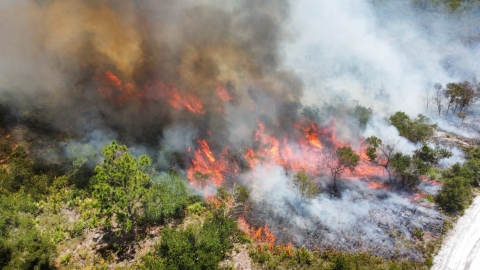
A prescribed burn is the controlled use of fire to restore wildlife habitat, reduce wildfire risk, or achieve other habitat management goals. We have been using prescribed burn techniques to improve species habitat since the 1930s.
Learn more about prescribed burn in July 2025 cleared dead vegetation and the remaining invasive underbrush in areas previously treated with herbicide, reducing wildfire risk and improving access for future maintenance.
Building Local Capacity
Feeling empowered by success, the club conducted its first maintenance staff-led prescribed burn in their quail fields in June 2025. They have additionally applied for further cost share and technical assistance from the Florida Forest Service and Natural Resources Conservation Service.
Long-Term Conservation Benefits for Wildlife and Residents
This project supports outdoor recreation, species recovery, infrastructure protection, and the use of innovative tools. It also emphasizes efficiency and collaborative conservation. The IHHRC partnership demonstrates how modern tools and community engagement can deliver meaningful conservation outcomes.
For additional background on this work, see the project summary prepared by the drone operator: Aerial Survey Drone Project in Indian Hammock, Florida: Evaluating the Impact of Lygodium Control Efforts.