By Vanessa Morales in collaboration with USFWS Pacific Southwest Region and Death Valley National Park

In the seemingly bottomless depths of Devils Hole in southwest Nevada, there was a terror lurking below. But it wasn’t some type of science fiction sea monster lurking in the depths.
The terror was the looming potential of wild extinction for the Devils Hole pupfish, the rarest fish in the world.
A March 2025 dive found only 20 or so of the tiny fish that only exist at Devils Hole, a detached unit of Death Valley National Park within the boundary of the U.S. Fish and Wildlife Service’s Ash Meadows National Wildlife Refuge. These fish, between 1 to 1.5 inches long with males an iridescent blue and females an olive-green color, have special adaptions that allow them to live in the water-filled limestone cavern’s 92-degree Fahrenheit geothermal waters. This entire population of pupfish primarily feeds and breeds on a shallow 215-square foot natural shelf on one side of Devils Hole. The fish feed primarily on algae that grows on the limestone shelf and on small invertebrates.
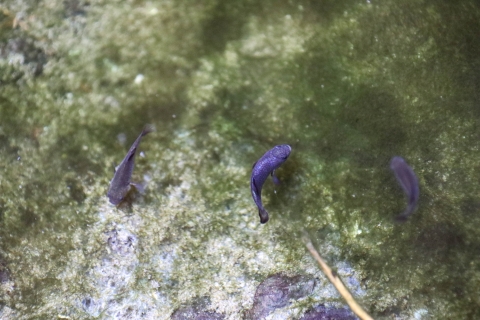
The cause of the sudden population drop in early 2025 was clear: habitat disruption caused by earthquake-generated waves in December 2024 and February 2025. These six-foot waves sloshed around inside of the cavern like water in a washing machine, sweeping algae and fish eggs off the shallow shelf and into the cavern’s depths.
While this put the fish’s future in peril, there was a team of biologists from the National Park Service, Nevada Department of Wildlife and U.S. Fish and Wildlife Service standing at the ready.
The multiagency team acted quickly, following the existing strategic plan, and released Devils Hole-derived fish from the Ash Meadows Fish Conservation Facility back into the wild—an action that was instrumental in ensuring the wild population’s survival. This was the first time that captive Devils Hole pupfish have been returned to the wild.
"We were fortunate we had a strategic plan that allowed us to act cautiously but swiftly, moving the refuge tank fish to Devils Hole to assist with recovery,” said Kevin Wilson, aquatic ecologist and Devils Hole Program Manager with Death Valley National Park
“This plan was instrumental in ensuring the wild population’s survival—for this decision it provided both the recovery options and timing agreed upon by our multi-agency team,” said senior fish biologist Michael Schwemm with the U.S. Fish and Wildlife Service.
The first-ever transfer of 19 fish from captivity was characterized by extreme caution. Biologists moved fish while limiting their exposure and handling time to an absolute minimum. Subsequent transfers over the next year were less unnerving and time-sensitive, incorporating additional fin-clips, health assessments and acclimation steps to improve success.
The Devils Hole pupfish population is now steadily increasing, rebounding from the significant decline in 2025 caused by earthquake activity and limited food availability.
During the spring 2026 count, 77 fish were counted, nearly four times the number seen during that ominous dive back in March 2025. This shows that pupfish are reproducing again in Devils Hole. In addition, several hundred remain in captivity at the Ash Meadows Fish Conservation Facility.
The staff from the U.S. Fish and Wildlife Service, the National Park Service and the Nevada Department of Wildlife continue to work together to support both the wild and captive population, strengthening the Devils Hole pupfish’s long-term resilience.

What is Devils Hole?
While there are several local legends and theories on where the seemingly bottomless cavern got its name, the mysteriousness of Devils Hole’s depths and natural phenomena undoubtedly adds to its intrigue. Professional scuba divers have mapped Devils Hole’s depth to nearly 450 feet, but the bottom has never been found.
The water in Devils Hole changes very little with the seasons. The geothermal pool within the cave maintains a relatively constant 92-degree water temperature. The pool is in shadow all winter and only receives direct sunlight in the summer.
Yet, once every few generations of pupfish, conditions can change dramatically in Devils Hole. Earthquakes thousands of miles away can cause waves up to 6 feet tall inside of the cavern. The cavern itself is also susceptible to earthquakes, tsunamis and both human-caused and natural environmental changes leading to declining water levels, creating threats to the endangered population of fish residing within it.
The water level over the shallow shelf started to decline in the late 1960s. The Devils Hole pupfish became protected under the Endangered Species Act in 1967. Since then, federal and state agencies have worked together to conserve the species. A landmark Supreme Court case (Cappaert vs. U.S.) in 1976 recognized a water right for Devils Hole, protecting a sufficient water-level for the shelf that the pupfish rely on for food and spawning.
Biologists from the U.S. Fish and Wildlife Service, National Park Service and Nevada Department of Wildlife have been counting Devils Hole pupfish nearly every spring and fall since 1972. The multi-agency team splits up to count fish simultaneously from the surface and by scuba diving into the cavern. There are usually more fish in the fall than spring due to algae growth stimulated by direct sunlight in the summer. From 1972 through the mid-1990s, there were an average of 200 fish counted each spring and 425 counted each fall.
The number of Devils Hole pupfish then started a mysterious decline in numbers, dropping to 35 fish in spring 2013 and only 65 in fall 2013.
A Pupfish Lifeboat
The multi-agency team had attempted to establish new populations of Devils Hole pupfish since the 1970s, but each attempt failed due to the technical and biological challenges of keeping this unique species in introduced habitats.
In 2013, through a Southern Nevada Public Land Management Act grant, the Ash Meadows Fish Conservation Facility was built to house a captive population of Devils Hole pupfish and conduct research to support conservation of Devils Hole pupfish and Devils Hole, completely transforming and enhancing the way biologists could work to preserve the species. The facility contains a 100,000-gallon tank that includes replicas of parts of the shallow shelf habitat and the deep pool ecosystem of Devils Hole, and state-of-the-art-the-art equipment built to maintain their environmental parameters. The primary purpose of the captive population at the facility is to ensure the species does not become extinct, serving as the as a source of fish for Devils Hole should that become necessary.

The lifeboat population is continually maintained by the transfer of individuals from the wild population. Eggs are collected each month from Devils Hole, raised to adults in aquariums, and released into the 100,000-gallon refuge tank. This ongoing transfer of fish maintains genetic similarity between the wild and captive populations. Each fish released into the large refuge tank is fin-clipped to preserve a genetic sample for future analysis. Similarly, fish propagated directly from the refuge tank are also fin-clipped, allowing periodic population genetic analysis of fish derived from both populations. Previous genetic research has shown that fish in the refuge tank and the wild Devils Hole population are genetically very similar but maintain slight differences that may be important for conservation.
The movement of adult fish from the refuge tank to the wild population follows recommendations from the Devils Hole Pupfish Strategic Plan, which considers transfers during instances of extremely low abundance. The goal of this management action is to avoid extirpation of the population in Devils Hole.
Learn more about Devils Hole and the Devils Hole pupfish: