People from all over the globe thirst for a chance to catch golden treasures found within the cold, mountainous waters of the American Southwest. They are not panning for gold; instead, they are angling to hook the Gila trout and the Apache trout. But the sun almost set forever on these invaluable fish.
The arduous trek from the desert floor through the rough mountainous terrain to reach their cold-water streams is emblematic of the recovery of the species. Working together through challenges and rewards, a determined group of partners have made sure that the fish remain and flourish—for us and for future generations.
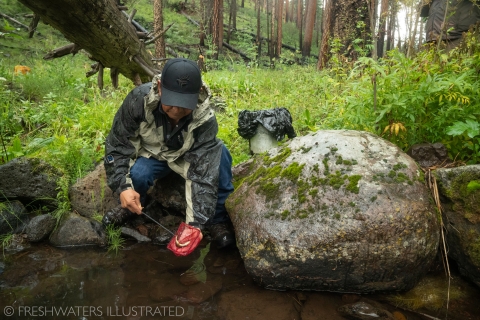
“These fish only exist in really rugged and breathtakingly beautiful places in one small part of the world,” said Zac Jackson, biologist and species lead for the Apache trout with the Service’s Arizona Fish and Wildlife Conservation Office. “The fact that these fish are still around in these isolated areas feels like a testament to their perseverance.”
In 2006, Gila trout was reclassified from endangered to threatened with a specific stipulation to allow fishing in designated recreational streams. Then in 2024, Apache trout was the first gamefish to be removed from the Endangered Species list due to recovery. Federal, state and tribal partners along with universities, private organizations and recreational anglers formed the foundation for recovery efforts. These committed relationships continue to flourish, along with the fish.
“The Gila and Apache trout success stories are some of the best examples of the U.S. Fish and Wildlife Service’s collective conservation mission,” said Robert Prather, biologist and species lead for the Gila trout with the Service’s New Mexico Ecological Services Field Office. “Recovering both species is only achievable because of our partners. These achievements wouldn't have been possible without them.”
Collective Efforts to Save Rare Trout
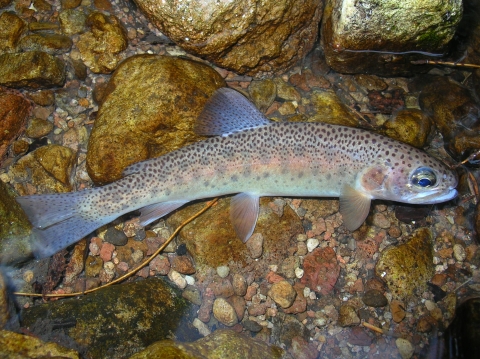
The Gila trout is found in both New Mexico and Arizona, while the Apache trout occurs only in Arizona. These trout live in high-elevation streams across the montane forests of some truly wild and remote places. Their small ranges and unique niches put them at risk. Habitat loss, wildfires, historic overfishing practices, and non-native fish have made these species especially vulnerable to extinction.
Alarmed by the decline in trout populations, conservation leaders acted quickly and early. The Gila and Apache trout are the “old school” of ESA-listed species, having been among the first species listed as endangered over 50 years ago. Protection for these species came first from state and tribal governments.
“Conservation efforts in New Mexico began in the 1920s and continue to this day,” said Jill Wick, native fish program manager for New Mexico Department of Wildlife. “Efforts have focused on removing or mitigating threats to the species and removing nonnative trout so that we can return Gila trout to their historical range. We focus on restoring Gila trout to larger, interconnected stream drainages so that the fish have a better chance of surviving largescale disturbances like large wildfires.”
Recovering Gila trout has long been a priority for New Mexico Department of Wildlife. They became a key player in Gila trout recovery over a century ago and remains so today, joining other partners in conservation efforts including the U.S. Fish and Wildlife Service, the U.S. Forest Service, Arizona Game and Fish Department, and Trout Unlimited. New spawning and raising techniques at Mora National Fish Hatchery continue to improve the chances for the threatened Gila trout. Partners gather annually to share lessons learned, best practices and creative ways to solve new problems.

For the Apache trout, conservation efforts by the White Mountain Apache Tribe occurred before the Endangered Species Act existed. The tribe established habitat protection measures and angling closures to preserve the few remaining populations of Apache trout. Even today, sport fishing is not allowed on tribal lands in certain streams that are essential for species recovery.
"Our traditional Apache leaders understood long ago that protecting the Apache Trout meant safeguarding the ecosystem around it—knowing that everything in our world is connected,” said Tim Gatewood, fisheries manager for the White Mountain Apache Tribe. “And we continue carrying forward the vital work they began. Every day, I am reminded that this is more than a job; it is a calling rooted in respect, gratitude, and stewardship for our lands and waters."
The White Mountain Apache Tribe, Arizona Game and Fish Department, the U.S. Fish and Wildlife Service, the U.S. Forest Service and Trout Unlimited joined together to form a cooperative management plan for the long-term conservation of the Apache trout.
"The delisting of Apache Trout is one of the greatest conservation success stories—all due to the collaboration and partnership among the state and federal agencies, tribes, and Trout Unlimited, each having specific missions and statutory responsibilities, but all believing in the possibility of the recovery of Apache Trout,” said Julie Meka Carter, aquatic wildlife branch chief for Arizona Game and Fish Department. “I'm incredibly grateful for the White Mountain Apache Tribe's leadership in these efforts, and the dedication and passion of countless individuals who have worked to manage and protect this unique and special species."
Perseverance of the American Spirit

The long-term stewardship of these trout reflects the deep dedication of conservation leaders in the American Southwest. These trout species are management-dependent, meaning the fish will always require some level of management even when recovery goals are met because threats to the species cannot be eliminated, only addressed. Obstacles to the recovery efforts occur, but the work continues because of the resilient partnerships.
“Every time have we have one success, there's a wildfire, there's a drought, or we encounter a new setback,” said Serena Kucera, fish biologist with the Service’s New Mexico Fish and Wildlife Conservation Office. “That's just how it is, and we have to work through this. We have to adapt, and we have to keep pushing forward and advocating for the fish.”
Coordinated responses to dozens of natural disasters, often requiring evacuation of fish populations, have helped save the species. Once an area recovers after a wildfire or drought, fish are restocked using various means.
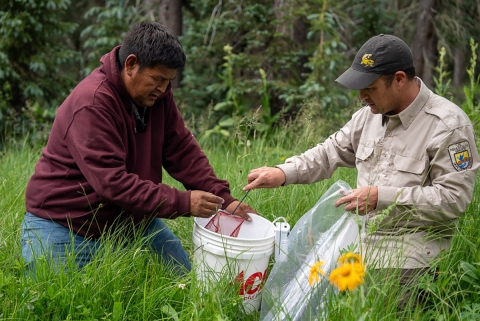
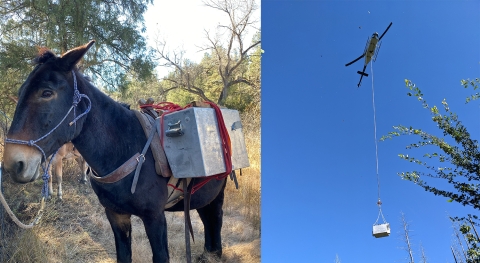
Sometimes resolute hikers sporting a 5-gallon bucket full of water, fish and oxygen strapped to their external frame backpack does the trick. At other times, biologists climb across steep terrain alongside mules or horses carrying insulated boxes. On occasion, helicopters fly through remote wilderness areas, hauling a dangling aluminum box specifically made for this task. Teams on the ground quickly work with the hovering craft to rescue fish from wildfire compromised streams or to deliver them to recovery streams.
The collective conservation efforts continue forward, despite the stumbles, and all this hard work is worth it. Help is found and welcomed through various channels such as recreational anglers who may know more about the streams than the experts. Knowledge is shared freely through annual meetings, publications of peer-reviewed research articles, and updated recovery plans.
Our Natural Resource Legacy

Partners show up for each other, for the species and for conservation. Year after year, decade after decade, the collaborative conservation work continues regardless of the setbacks. They do all of this to spread the best science about trout conservation and for the species to survive. They do this so that we can still fish for these treasures.
“Bringing people out to these incredible places and fishing is what keeps me going,” said Ryan Gordon, fish and wildlife biologist with the Service’s Ecological Services Office in Arizona. “I want to keep educating my kids and the public about the importance of protecting these species and ongoing conservation.”
The recovery work for the Gila trout and the Apache trout is a commitment to conserve, protect, and improve habitats for the continuing benefit of future generations. You can learn more about the monumental actions to prevent extinction and recover these species in these videos that showcase Gila trout conservation and Apache trout recovery. Learn more about the shared pursuit to save the Gila trout and the Apache trout.