Written By

The Lower Rio Grande Valley (LRGV) in south Texas is one of the most biodiverse regions in the United States, has over 520 bird species documented, and is recognized by The American Bird Conservancy as a “globally important bird area” that provides habitat for a variety of migratory, wintering, and resident birds. The Coastal Program, working with numerous partners, is investing in preserving, restoring, and maintaining habitats in the LRGV, especially coastal prairies, an important habitat for grassland dependent birds. One notable iconic grassland dependent species is the Federally endangered Northern Aplomado Falcon.

Recently, the Coastal Program coordinated efforts between the Laguna Atascosa National Wildlife Refuge (NWR), Palo Alto Battlefield National Park (NP), and The Peregrine Fund (TPF) to identify and assess coastal prairie sites needing restoration on Refuge and National Park Service lands. Following site assessments, the Costal Program assisted TPF in drafting a National Fish and Wildlife Foundation (NFWF) – ConocoPhillips SPIRIT of Conservation Program grant proposal. Subsequently, NFWF awarded TPF $250,000 to restore coastal prairies through the mechanical and chemical control of invasive brush and to monitor bird community response to management actions.
Beneficial management practices to restore grasslands at Laguna Atascosa NWR and Palo Alto Battlefield NP, has the potential to increase their value as habitat for grassland dependent species and at Palo Alto Battlefield NP, restore the site’s historical character. Palo Alto Battlefield NP exists to preserve and interpret the sites of the two opening battles of the Mexican- American War, for the education, benefit, and inspiration of present and future generations. In recent years, invasive brush has encroached into the historic battlefield reducing interpretation opportunities and suitable habitat for the Northern Aplomado Falcon.
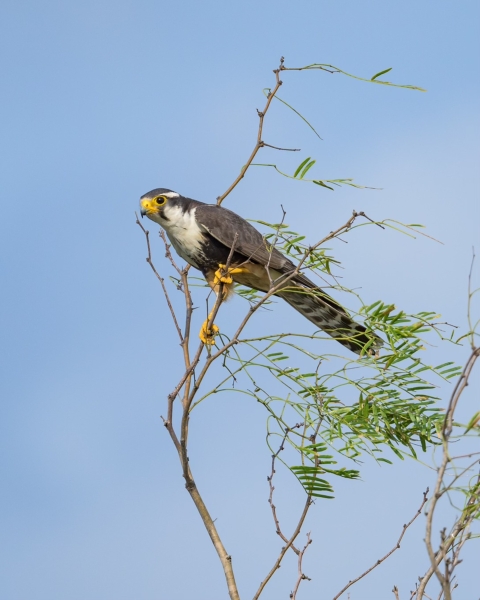
The Peregrine Fund and its partners, including Federal, State and private entities have been working to restore the Aplomado Falcon, a species listed as endangered by the U.S. Fish and Wildlife Service (USFWS) in 1986 in response to its extirpation in the U.S. Through releases of captive-reared falcons, a population was established in coastal Texas that persists to this day. The Aplomado Falcons require a nearly treeless expanse of yucca-studded coastal prairies and saltmarsh like those especially found in the LRGV region of the Texas Gulf Prairies and Marshes ecoregion. A nesting pair requires roughly 2,000 acres of this habitat, which is increasingly difficult to find as much of the coastal prairie and saltmarsh have been lost to encroaching brush and the absence of the naturally occurring fires. Invasive brush encroachment into coastal prairie is a major impediment to falcon recovery because it brings falcons into contact with their primary predator, the Great Horned Owl.
This project is the first of its kind in the LRGV to incorporate bird community monitoring. The monitoring results will be used to inform future management decisions.