Written By

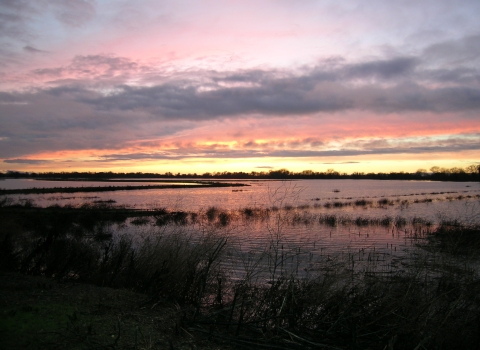
The Bahia Grande basin, located within Laguna Atascosa National Wildlife Refuge (LANWR) in Cameron County, Texas, is a nearly 10,000‑acre estuarine wetland that historically served as an important nursery for fish and shellfish, provided wintering habitat for waterfowl and supported foraging and nesting island habitat for colonial waterbirds. This changed in 1936, when construction of the Brownsville Ship Channel cut off the basin’s tidal connection to the Lower Laguna Madre, causing the basin to dry and creating a significant dust hazard for local communities for nearly 70 years.

The U.S. Fish and Wildlife Service acquired the Bahia Grande tract in the early 2000s and began working with more than 60 partners to restore tidal connectivity. In 2005 their efforts led to the successful construction of a new channel, reconnecting the basin to the Brownsville Ship Channel. For the first time in nearly a century, tidal flow returned to the Bahia Grande, transforming the dry and bare basin into a thriving sanctuary for fish, birds and wildlife.
Within a few years, seagrass began to re-establish in the wetlands, and the basin once again became a productive nursery supporting robust populations of fish, shrimp, blue crabs, wintering waterfowl, and foraging habitat for colonial waterbirds. However, one challenge remained: the islands that once provided nesting habitat for colonial waterbirds had been covered by wind‑blown sediment during the dry years. This killed off the island's native brush and allowed invasive grasses to take over, making the islands unsuitable for nesting waterbirds.
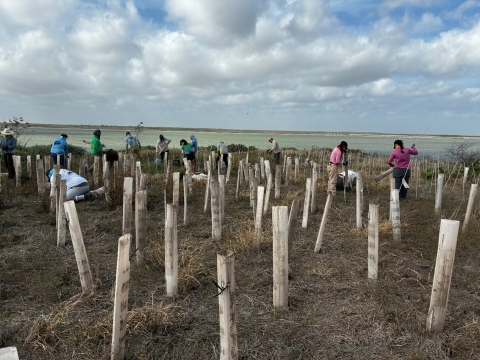
In 2023, the Service's Coastal Program, LANWR, and the Coastal Bend Bays & Estuaries Program (CBBEP) partnered to address this issue and restore nesting habitat on one of the two natural islands in the basin. Restoration efforts began with prescribed burns and herbicide treatments to manage invasive grasses and prepare sites for planting native brush species.
Native brush plantings began in November 2023, and what started as a small project has now become an annual event that many look forward to. To date, more than 3,000 native seedlings have been planted. At the latest planting event on April 2, 2026, more than 40 volunteers from local universities and organizations including American Forests, Texas Master Naturalists and the Native Plant Society showed up to plant seedlings. Volunteers also installed protective tree tubes around each seedling, which help to increase the seedling’s survival and growth. In under six hours, volunteers planted 980 seedlings representing 17 native species.
Monitoring conducted by USFWS and CBBEP has shown approximately 90% seedling survival, with plants growing from initial heights of 10-20 inches to more than six feet. Restoration of this island is expected to be completed in spring 2027, and the site is anticipated to once again provide nesting habitat for many species of waterbirds, including reddish egrets, great egrets, snowy egrets, great blue herons, little blue herons, tricolored herons, and roseate spoonbills.