States
MissouriOverview
The southwest Missouri portion of the Tri-State Mining District consists of an inactive mining area containing numerous mine waste sites spread across hundreds of square miles in Jasper County and Newton County, Missouri (“TSMD Jasper/Newton Site” or “Site”). As a result of mining and related activities, large amounts of metals such as cadmium, lead, and zinc have been released, and are continuing to be released into Missouri's environment. In addition to this Site, the Tri-State Mining District (TSMD) includes two additional Superfund Sites located in Kansas and Oklahoma, encompassing thousands of acres of impacted land, and hundreds of miles of contaminated streams. The metals associated with mining are potentially toxic to a wide variety of plants and animals.
Trustees
Under the Comprehensive Environmental Response, Compensation and Liability Act (CERCLA), and its implementing regulations, the Director of the Department of Natural Resources (Missouri DNR) and the U.S. Department of the Interior (DOI) are Trustees for natural resources in the TSMD (the “Trustees”). Missouri DNR and DOI exercise trusteeship over natural resources, including surface waters (rivers, lakes, streams, etc.), ground water, soils, air, plants, and animals. As Trustees, the State of Missouri and DOI serve as stewards for these resources and have the authority to assess whether the resources and their services have been injured as a result of release(s) of hazardous substances. Injuries to natural resources may occur if the resources are exposed to concentrations of hazardous substances that are high enough to cause adverse effects.
Natural Resource Damage Assessment and Restoration Process
The purpose of a natural resource damage assessment and restoration (NRDAR) is to restore natural resources injured from a release of hazardous substances into the environment. DOI conducts damage assessments that provide the basis for determining the restoration needed to compensate for the public’s loss of natural resources, following its promulgated and published NRDAR regulations found at 43 CFR Part 11. These regulations provide procedures by which trustees can identify natural resource injuries, quantify those injuries, determine appropriate compensation (damages) for the injured resources and the services they provide, and restore those injured resources. The NRDAR process includes the following steps, specifically:
- Pre-assessment
- Assessment planning
- Assessment
- Post-Assessment Planning and Implementation
The Trustees completed a Preassessment Screen and Determination and Notice of Intent to perform a natural resource damage assessment for the TSMD Jasper/ Newton Site in 2008.
Assessment
- Effects of mining-derived metals on riffle-dwelling crayfish and in southwestern Missouri and southeastern Kansas of the Tri-State Mining District, USA (2011)
- Appendix A for Effects of mining-derived metals on riffle-dwelling crayfish and in southwestern Missouri and southeastern Kansas of the Tri-State Mining District, USA (2011)
Restoration
Restoration is any action or combination of actions that restore, rehabilitate, replace or acquire the equivalent of injured natural resources and services.
Restoration Plans and Projects
The Trustees have developed multiple Restoration Plans to fund restoration projects using recoveries from several settlements within TSMD Jasper/Newton Site. For each Restoration Plan, the Trustees evaluated a range of restoration actions and alternatives, which will restore, rehabilitate, replace and/or acquire the equivalent of those natural resources and their services that were injured.
TSMD Striketeam
The trustees have funded a Pheasants Forever, Inc. and Quail Forever (PFQF) striketeam to work in Southwest Missouri for 5 years. This project shares costs with funds supplied by the Bipartisan Infrastructure Law Bipartisan Infrastructure Law
The Bipartisan Infrastructure Law (BIL) is a once-in-a-generation investment in the nation’s infrastructure and economic competitiveness. We were directly appropriated $455 million over five years in BIL funds for programs related to the President’s America the Beautiful initiative.
Learn more about Bipartisan Infrastructure Law . Restoration and maintenance of natural environments requires considerable commitment and expense and is achieved more effectively and sustainably through partnerships. The striketeam will work with trustees and other resource agencies on projects to restore and maintain resources that were injured by contaminants released into the environment during mining and smelting activities in the Tri-State Mining District. Proposed projects include treating invasive species invasive species
An invasive species is any plant or animal that has spread or been introduced into a new area where they are, or could, cause harm to the environment, economy, or human, animal, or plant health. Their unwelcome presence can destroy ecosystems and cost millions of dollars.
Learn more about invasive species , expanding prescribed fire activity and diversifying and restoring native habitats within and around the Springfield Plateau ecoregion, which has been impacted by historic mining activities.
Final Long Term Restoration Maintenance Restoration Plan Amendment
The Trustees amended two Restoration Plans and an agreement in order to provide funding for third-parties to maintain, monitor and administer long-term stewardship of previously funded restoration projects using Natural Resource Damage Assessment and Restoration (NRDAR) funds obtained through various settlement agreements and bankruptcy proceedings.
Access the Final Long Term Restoration Maintenance Restoration Plan Amendment
Joplin Parks Project Final Restoration Plan
The Trustees will use restoration funds to convert mowed fescue parkland into native prairie habitat within several Joplin parks. A public meeting was held at Joplin City Hall on July 1, 2019, and the City Council unanimously voted to implement the project with the Trustees.
Access the Joplin Parks Project Final Restoration Plan
Cardinal Valley Habitat Restoration Final Restoration Plan /Environmental Assessment
The Trustees will fund the restoration of former mined lands through the application of compost and subsequent prairie restoration on land owned by the municipality of Webb City.
Access the Cardinal Valley Habitat Restoration Final Restoration Plan /Environmental Assessment
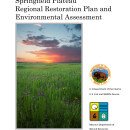
Springfield Plateau Final Regional Restoration Plan
The Trustees have created a regional restoration plan that defines how and where NRDAR funds should be spent.
Access the Springfield Plateau Final Regional Restoration Plan