



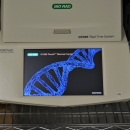
Topeka Shiner (Notropis topeka) is a minnow that inhabits small prairie streams and oxbows in the Central U.S. The species was listed as endangered under the U.S. Endangered Species Act in 1998 (USFWS 2018) as the result of habitat loss and declines in distribution and abundance. Updated information on the species distribution and habitat occupancy is important for evaluating recovery status; however, limited data exists in many areas. Physical sampling for Topeka Shiners (primarily seining) can be difficult due to local habitat conditions and the broad distribution of Topeka Shiners across their range. eDNA can be used as a monitoring tool to help in the detection and distribution of Topeka Shiners and inform future physical monitoring events (USFWS 2021). Efforts to support physical monitoring are crucial as physical monitoring can provide specific population level dynamics that are required for delisting the species (USFWS 2021).
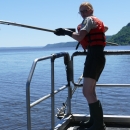
Previously the La Crosse FWCO and the Whitney Genetics Lab conducted studies to optimize qPCR-based eDNA methods for Topeka Shiners in oxbow habitats in Iowa and Minnesota (DeHaan et al. 2025). These studies resulted in sampling recommendations for future monitoring efforts. Additionally, a pilot study using these methods to detect Topeka Shiners in mainstream pooled habitats in southwest Minnesota was completed in 2023. Topeka Shiner detections from lab results were validated by collections of shiners by physical sampling (i.e., seining). Physical sampling of Topeka Shiners in some of the mainstem tributaries of the North Racoon watershed, has yielded variable results. Due to the difficulty in finding Topeka Shiners in the North Raccoon, their presence may be underrepresented or unknown in its subwatersheds. In the North Raccoon watershed, shiners may be taking refuge in scour pools that have formed at road crossings and slack water areas around bridge piers, which could emulate optimal habitat conditions, such as preferable substrate or water quality. Mainstem scour pools typically have reduced flow during the summer where eDNA can pool near the water surface where water samples are collected.
Our objective for 2025 was to assess the presence/absence of the endangered Topeka Shiner in pooled mainstem habitats associated with road crossings in Iowa’s North Raccoon River watershed using eDNA methods. eDNA detection data collected in this study will be used to prioritize sites for future physical sampling, to clarify site occupancy by Topeka Shiners, and to prioritize conservation and management actions.
Author(s)

Biological Science Technician
Fish and Aquatic Conservation,
Aquatic Invasive Species

Project Leader
Fish and Aquatic Conservation
Area
WI
IL
IA
MN
MO
MI
Onalaska,WI

Fish Biologist
Fish and Aquatic Conservation
Expertise
eDNA,
Round Goby
Area
IL
IA
MN
MO
WI
Image
Fish Biologist
Fish and Aquatic Conservation,
National Fish Passage Program
Area
IA
MN
WI
Onalaska,WI

Fish Biologist
Fish and Aquatic Conservation,
National Fish Passage Program
Area
MN
IA
Onalaska,WI
Publication date
Type of document
Report
Facility
Media Usage Rights/License
Public Domain
Program

Species

FWS Focus
FWS and DOI Region(s)